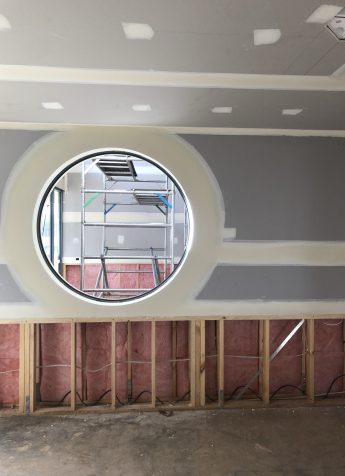
Levels of Finish
Levels of finish are defined in the Australian/New Zealand Standard AS/NZS2589. This standard is intended to provide builders, plasterboard installers and finishers, and their customers with the various defined methods and practices necessary to meet the customer’s expectations in terms of the ‘Level of Finish’.
Three ‘Levels of Finish’ (3, 4 and 5) are defined, and minimum specifications to achieve each level of finish are detailed in the standard for each of the installation processes from framing preparation to finishing. All details may not be suitable for fire rated systems or multilayer systems.
It is essential to determine the level of finish required before the frame construction begins, as specific tolerances are required for frame alignment as well as for plasterboard fixing and finishing for each of the levels of finish. Unless these requirements are met throughout construction, it may not be possible to attain the desired finish level without extensive corrective measures.
The level of finish specified also affects the methods of jointing, particularly butt joints and back-blocking requirements, the number of coats of joint compound applied, and the fitting and finishing of stopping beads. Refer to TABLE 2.
It should be noted that, generally, residential applications should be prepared to a minimum ‘Level 4 Finish’ unless specifically a higher or lower level of finish is agreed to by all contracting parties. Other commercial applications should be specified in contract documents.
Selection of Level of Finish
Factors affecting the level of finish include the surface’s visibility, the texture and gloss level of the final decoration and the lighting conditions. Critical or glancing light is that projected across the surface at low angles of incidence, as opposed to diffused lighting or light striking the surface at close to right angles. Refer to the following section “Surface Finishing & Lighting”.
A good method to overcome differences in opinions of quality is to prepare a sample area in a suitable position and for all parties to agree on the finish. The following flow chart will assist in selecting the most appropriate Level of Finish for each area.
For further information on levels of finish, refer to ‘Plasterboard Expectations’, available from the Association of Wall & Ceiling Industries.
LEVEL 3
For use in areas that do not require a finish, such as above ceilings and inside service shafts and other inaccessible spaces. All joints are to be taped with two applications of compound and all fastener heads are to be covered. Compound is to be finished smooth, such as by scraping ridges etc with a trowel.
LEVEL 4
This is generally the accepted level of finish for residential construction. Joints are to have a tape coat, and two separate coats are to be applied over the tape coat and fastener heads. All joint compound should be sanded to a smooth finish free of tool marks and ridges. Full details can be found in the Jointing section.
Gyprock One Finish is a pre-mixed acrylic compound designed to create a uniform surface on interior walls and ceilings affected by critical lighting conditions. The application of One Finish over a standard level 4 finish will improve the final surface and minimise the effects of critical light, however it will not automatically upgrade the work to a level 5 finish.
LEVEL 5
This level of finish should be used wherever gloss or semi- gloss paints are to be used, where paint is mid or dark coloured, or where critical light conditions occur such as from windows, skylights, or silhouette and spot lighting.
A three coat jointing system is required as for level four. All joint compound should be sanded to a smooth finish free of tool marks and ridges. This should be followed by the application of proprietary surface preparations by skim coating to remove differential surface textures and porosity.
Skim coating is a term used to describe a thin finish coat, rolled, trowelled or airless sprayed and then possibly sanded, to achieve a smooth and even finish. It is normally less than 1mm in thickness and is applied over the entire surface to fill imperfections in the joint work, smooth the paper texture and provide a uniform surface for decorating.
Attribution: CSR Residential Installation Guide. The RED Book.


 Phil The Cracks Plastering LAUNCESTON