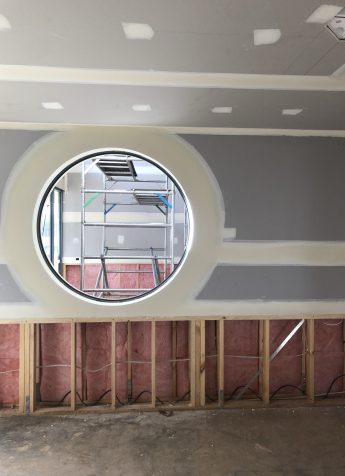
Use angled sanding block. Plaster Repair

Hi All.

Just a quick one here on sanding and plaster repair. If you remember back to last posting i was talking about taping in internal angles using paper tape. Well as you can see on your left the wall and nib wall are now got a coat of paint on it. But before i painted i had to sand this area. After i used my dustless sanding machine you still have to go through and BLOCK sand the internals and anywhere else the machine could not reach. i.e around the power points etc.

If ever you end up doing this for yourself, make sure you buy the angled sanding blocks as you can see in the images below, not the straight edge ones, because with the angled sanding blocks you will not dig out the plaster on the other side of the internal as your sanding it. If you use a straight block it hits the other wall in the corner and digs out the plaster, leaving plaster repair work to be done.

Anyway just a quickie

Regards

Phillip Cordwell – http://ptcplastering.business.site

Square Set Openings

Here is a new square set opening. Framed with external angles, 2 x base coats and 1 x top coat. You MUST scratch/scrape plaster down between each coat, usually just before it fully sets.

There’s the square set opening in the background with the external angles on before it’s trowelled. Remember to use a level and builders square when installing or they can look really bad when painted 🙂

Phillip Cordwell – http://ptcplastering.business.site

Taping in internals by hand.

Right. i am at work at home and i’ve just taped in the corners. These are called in the trade internals. As you can see on the left photo that is a taped in internal. you put the plaster on both sides then you put over that the paper tape which you fold(it has a fold line in the centre of it). Once you have that in you blade it off with a 3 inch (angled) broad knife so you don’t spread the plaster to wide. And that’s it you have a taped in 90 degree corner which later on you top coat with a 4 inch blade and a special corner tool. i will explain that later.
cheers
phil

happy taping

Phillip Cordwell

Phil The Cracks Plastering – http://ptcplastering.business.site


What happens when owners sheet ceilings

Ok. I just sanded this job. Notice the 1m wide Butt Join in the Ceiling. I had to trowell this that wide because the owner sheeted this ceiling and he put the join 4m long in the centre of the ceiling. This is not the proper way to sheet. Butt Joins are always staggered at least 600 apart so they are easier to hide when the lights turn on. This ceiling will still be ok because of how wide i troweled it, but usually it shouldn’t be this way.

Phillip Cordwell –  http://ptcplastering.business.site